| The Big Bang: The Creation Myth of Physicists |

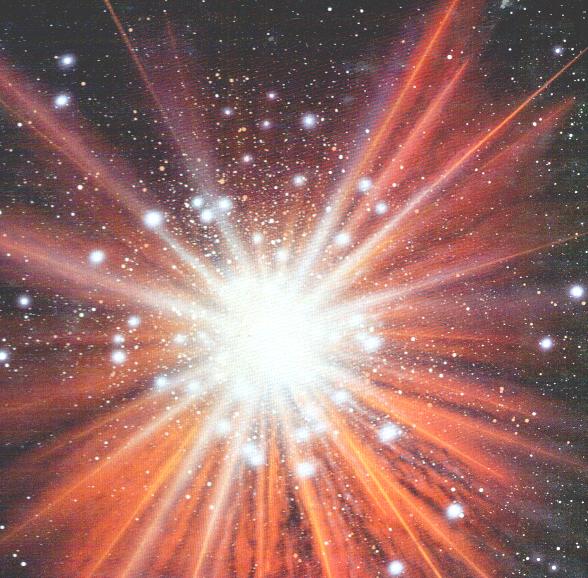
Theoretical Conception of the Big Bang Theory
Cited "Evidence" for the Big Bang Theory
Immediately Explicable Refutation of this "Evidence"
Neither the stellar/galatic distances nor the age of the universe provide proof of the Big Bang
Theory. Dark matter is accounted for by the aether theory as, well, aether. The cosmic radiation
we will researched later.
The Red Shift: The Foundation of the Big Bang Theory
The unifying "evidence" for which stellar/galatic distances, and age of the universe, are
considered supporting evidence, is the observation of "red shift." This is taken to mean that the
universe is expanding. Deduction from this inference led them to conclude that the universe must
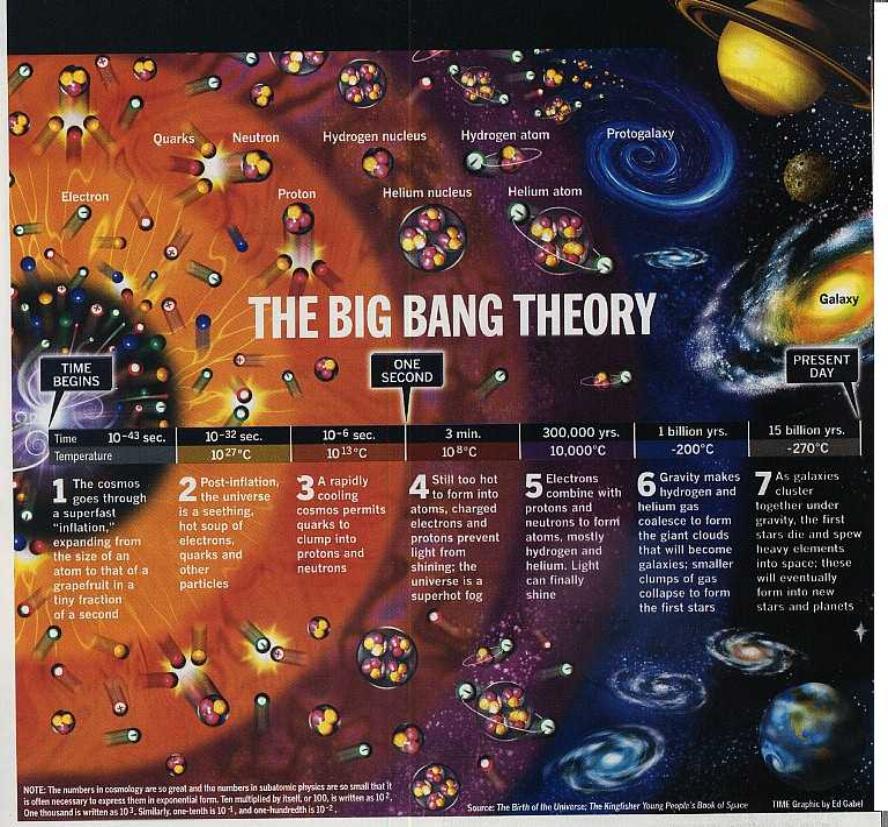
have originated in a singularity, afterwhich it burst, and expanded outwards.
- The Redshift of Light ("Expanding Universe")
- Stellar/Galatic Distances
- Age of Universe
- Cosmic Background Radiation
- Dark Matter
Immediately Explicable Refutation of this "Evidence"
Neither the stellar/galatic distances nor the age of the universe provide proof of the Big Bang
Theory. Dark matter is accounted for by the aether theory as, well, aether. The cosmic radiation
we will researched later.
The Red Shift: The Foundation of the Big Bang Theory
The unifying "evidence" for which stellar/galatic distances, and age of the universe, are
considered supporting evidence, is the observation of "red shift." This is taken to mean that the
universe is expanding. Deduction from this inference led them to conclude that the universe must
have originated in a singularity, afterwhich it burst, and expanded outwards.
This is a direct quote from Stephen Hawking's A Brief History of Time about the red shift
phenomenon:.
"[Hubble discovered] that most galaxies appeared red-shifted: nearly all were moving away from
us! More surprising still was the finding that Hubble published in 1929: even the size of a
galaxy's red shift is not random, but is directly proportional to the galaxy's distance from us. Or,
in other words, the farther a galaxy is, the faster it is moving away! And this meant that the
universe could not be static, as everyone previously had thought, but is in fact expanding; the
distance between the different galaxies is growing all the time" (42).
This is a direct quote from Hubble:
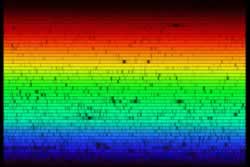
Galactic spectra are peculiar in that the lines are not in the usual places, as found in nearby light
sources. The displacements, called Redshifts increase on the average with the apparent
faintness of the Galaxy. Since the apparent faintness measures distances, it follows, that
redshifts increase with distance."
phenomenon:.
"[Hubble discovered] that most galaxies appeared red-shifted: nearly all were moving away from
us! More surprising still was the finding that Hubble published in 1929: even the size of a
galaxy's red shift is not random, but is directly proportional to the galaxy's distance from us. Or,
in other words, the farther a galaxy is, the faster it is moving away! And this meant that the
universe could not be static, as everyone previously had thought, but is in fact expanding; the
distance between the different galaxies is growing all the time" (42).
This is a direct quote from Hubble:
Galactic spectra are peculiar in that the lines are not in the usual places, as found in nearby light
sources. The displacements, called Redshifts increase on the average with the apparent
faintness of the Galaxy. Since the apparent faintness measures distances, it follows, that
redshifts increase with distance."
| Red Shift of Light |
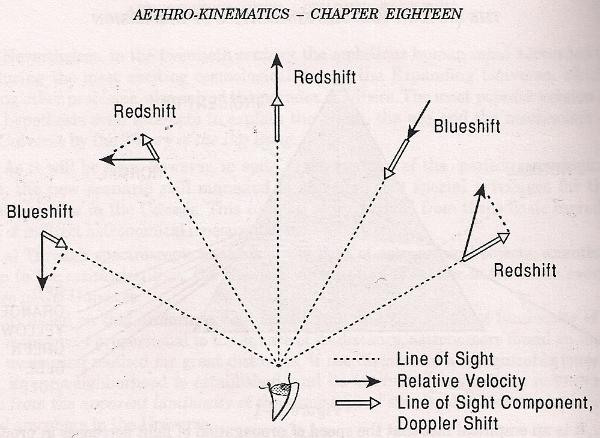
An Explanation of Red Shift: The Doppler Effect
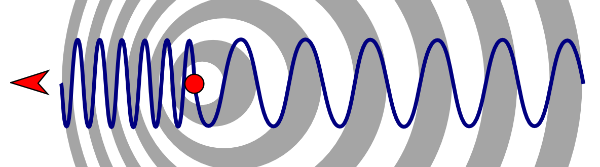
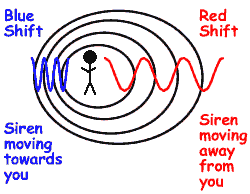
The frequency of an approaching light source's light wave shifts a given percentage toward the
higher frequency blue, and that of a receding source shifts toward the lower frequency red.
The frequency of an approaching light source's light wave shifts a given percentage toward the
higher frequency blue, and that of a receding source shifts toward the lower frequency red.
Receding source shifts
toward the lower frequency
red.
toward the lower frequency
red.
Approaching source shifts
toward the higher frequency
blue.
toward the higher frequency
blue.
| Animation of the Doppler Effect |
Source: Aethro-Kinematics
How the Big Bang Arose as a Theory
The Big Bang arose initially as an explanation for the Hubble expansion--the relation of the
redshifts and distances of galaxies.
This is a direct quote from Stephen Hawking's A Brief History of Time:
"At some time in the past the distance between neighboring galaxies must have been zero. At
that time, which we call the big bang, the density of the universe and the curvature of space-time
would have been infinite. Because mathematics cannot really handle infinite numbers, this means
that the general theory of relativity predicts that there is a point in the universe where the
theory itself breaks down. Such a point is an example of what mathematicians call a
singularity"(p.50).
The Big Bang arose initially as an explanation for the Hubble expansion--the relation of the
redshifts and distances of galaxies.
This is a direct quote from Stephen Hawking's A Brief History of Time:
"At some time in the past the distance between neighboring galaxies must have been zero. At
that time, which we call the big bang, the density of the universe and the curvature of space-time
would have been infinite. Because mathematics cannot really handle infinite numbers, this means
that the general theory of relativity predicts that there is a point in the universe where the
theory itself breaks down. Such a point is an example of what mathematicians call a
singularity"(p.50).
Failed Predictions of the Big Bang Theory
The Correlation Between the Doppler Effect and Red Shift Reconsidered
"'Hubble himself felt that the Doppler interpretation of redshift was not completely obvious and
insisted on using the wording 'apparent velocity' to indicate this. The term apparent velocity may be
used in carefully considered statements and the adjective always implied where it is omitted in
general usage....The arguments about the real nature of the observed redshifts has never been
settled...judgement may be suspended until it is known from observations whether or not redshifts
do actually represent motion" (A-K 457).
What the Doppler Effect Can and Cannot Tell Us
The only information the Doppler effect can give us is the direct line of sight component of the
velocity of the star. It cannot give us the velocity of a star at angels oblique to this line of sight.
- No objects in the universe are older than twenty billion years and larger than 150 million light-
years across. - there are. - The universe on a large scale should be smooth and homogenous. -- it isn't.
- To produce the galaxies we see around us from the tiny fluctuations evident in the microwave
background, there must be a hundred times as much dark matter as visible matter. -- there's
no evidence of this dark matter.
The Correlation Between the Doppler Effect and Red Shift Reconsidered
"'Hubble himself felt that the Doppler interpretation of redshift was not completely obvious and
insisted on using the wording 'apparent velocity' to indicate this. The term apparent velocity may be
used in carefully considered statements and the adjective always implied where it is omitted in
general usage....The arguments about the real nature of the observed redshifts has never been
settled...judgement may be suspended until it is known from observations whether or not redshifts
do actually represent motion" (A-K 457).
What the Doppler Effect Can and Cannot Tell Us
The only information the Doppler effect can give us is the direct line of sight component of the
velocity of the star. It cannot give us the velocity of a star at angels oblique to this line of sight.
| An Aethro-Kinematic Explanation |
The Tired Light Theory of Cosmic Red Shifts
The tired light theory suggests that the galactic red shift may be connected with the
depletion of the amplitude of light travelling through immense cosmical distances. The
shifting of the spectrum towards the red (lower frequency lower energy) occurs because of
the immense distance the light travels from the galaxy to earth.
- This is an empirical fact: light energy is distributed and depleted with distance in
accordance with the inverse square law. The energy of a light wave that we observe
emitted from a cosmic source is inversely proportional to the square of its distance. - This is an empirical fact: the energy a wave-motion carries is proportional to the square of
the amplitude of the waves. The amplitude of light must be in linear relation with the
distance of the source. The red shift of light is also in linear relation with the distance of
the source. - Olber's Paradox: our apparent center position of the universe (because everything seems
to be racing away from us). This is based on the simple fact that wherever we are, that
point is the center of our own limited observational territory.
The tired light theory suggests that the galactic red shift may be connected with the
depletion of the amplitude of light travelling through immense cosmical distances. The
shifting of the spectrum towards the red (lower frequency lower energy) occurs because of
the immense distance the light travels from the galaxy to earth.
Summation of Current Theory
The expansion of the universe creates a universal Doppler effect. Since it is expanding the
galaxies are all receding from us; this is perceived as a red shift of light on earth.
The expansion of the universe creates a universal Doppler effect. Since it is expanding the
galaxies are all receding from us; this is perceived as a red shift of light on earth.